
Book Blurb:
‘Tender Is the Flesh’ is a dystopian novel by Argentine author Agustina Bazterrica, where a virus makes all animal meat poisonous, leading to the legalization of cannibalism, with humans farmed for “special meat”. The story follows Marcos, a worker in a processing plant who becomes conflicted after receiving a live human specimen, forcing him to confront the brutal reality of his world and his own humanity. The novel explores themes of capitalism, dehumanization, and the nature of morality through its shocking premise, becoming a worldwide bestseller after its 2017 Spanish publication and 2020 English translation.
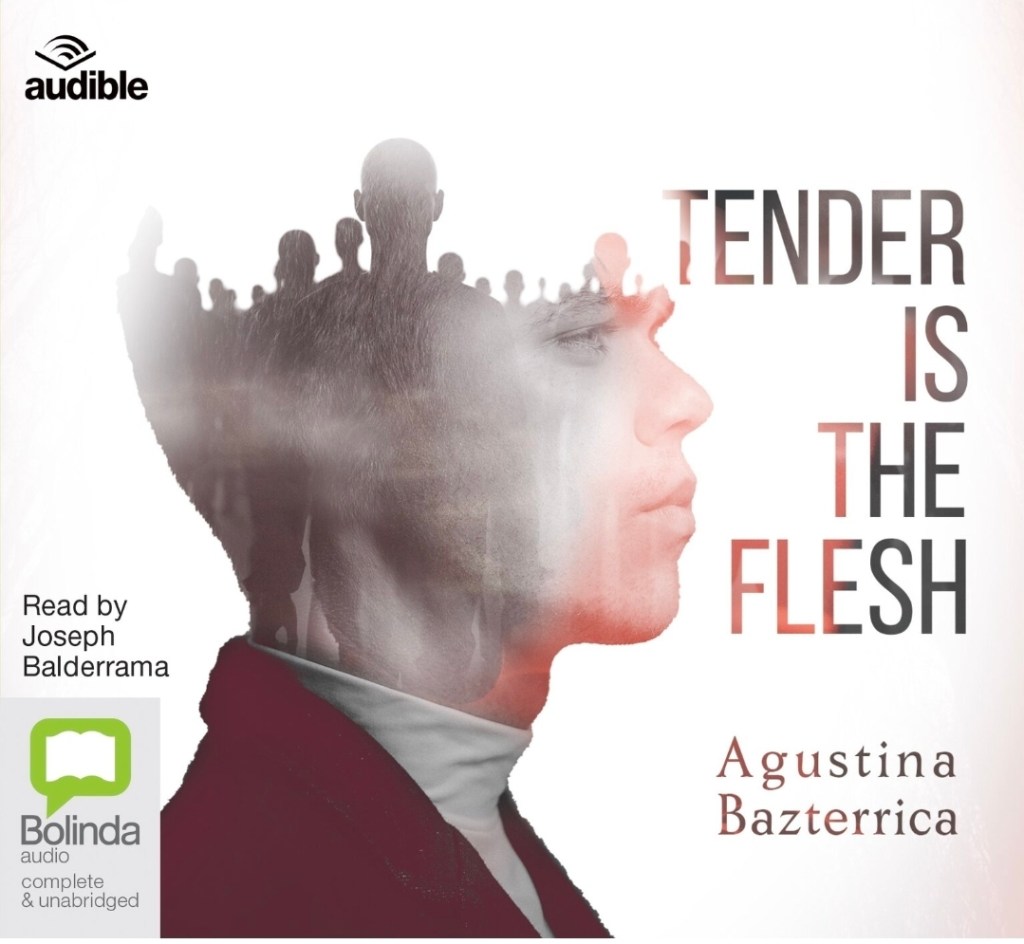
This book was quite a surpise for me. From the reviews I had seen and the way the book is advertised, I had thought this book was going to be a lot more ‘gory’ and horror based than I think it actually is. What is so horrifying about this book though, and the reason why I could not put the book down and have thought about it daily since finishing it, is that it is horrifying in how normal the entire concept of this book is. I also do not think that this book was written to be a scathing account of factory farming, but gosh does it do a fantastic job of it! If you were hesitant about giving up meat prior to reading this book, your mind will be changed by the end of it.
As explained in the blurb, cannabalism has been legalised and humans are now bred and raised for slaughter as part of the new meat industry. There were descriptions of slaughter that take place – such as how the ‘heads’ (the name given to the humans raised for meat) are slaughtered – but it is described in such a matter-of-fact way that it is very easy to forget that these are humans being killed. I would class this book as a horror, but I believe it is classed as ‘general fiction’ – it is dystopian, it is bleak, and whilst the subject matter is scary to think about, the story itself isn’t your typical horror book.
Which leads me to the reason why this book is so good and why I thoroughly enjoyed this book: The writing is beautiful. The language used throughout the book is very clever, and the descriptions used throughout as to how Marcos’ mind starts to deteroirat as the book goes on are so engaging and so engrossing that I could not stop reading. The language used throughout is also very similar to the language we use today to describe animals in factory farmign and animal agriculture: ‘pork’ instead of ‘pig’, ‘beef’ instead of ‘cow’, ‘live stock’ instead of ‘animal’. Within this book, humans used for slaughter are called ‘heads’, as it is illegal to call them humans. The meat is called ‘special meat’ rather than ‘human meat’, and animal terms are even used to describe the different parts of the human meat, such as ‘back trotters’ for human legs, or ‘front trotters’ for human arms. The language is used so casually within the book itself that the characters do not question it, and as a result you as the reader often have that horrible jolt back into reality when you remember that the meal that is being described to you is a peice of a human body.
This books covers so many interesting aspects of slaughter which are largely unspoken of in the reality of animal agriculture. Throughout the book, it is told to us over a series of different throw away lines or quick anecdotes that the turn over for employees at these human slaughterhouses is very, very high, due to the psychological damage it takes on a person who spends their whole day killing living beings. One story in particular talks of a stunner (a person hired to literally stun a person by hitting them on the head with a bat prior to slaughter, not dissimilar to how most animals are currently killed) who has a psyhcotic break and takes a chainsaw around the slaughterhouse attempting to free the humans from the cages. The man is fired, and a week later kills himself due to the guilt of what he has done in his job. This is very similar to the reality of animal agriculture, and the book even talks about how those employees who do stay in this line of work for the longterm tend to be either very disturbed individuals or complete shells of people who spend their working days completely disassociated from the work – blank behind the eyes, so to speak.
The cognitive dissonance throughout is also fascinating to see. As one would imagine, legalising cannabalism means that the idea of eating a human is no longer seen as taboo, and in one particular scene in the book, Marcos is told by his teenage neice and nephew about this new game that is going viral where children will bite each other to try and find out how each person tastes. But then his sister, their mother, tells the children off for talking about that game as it is ‘barbaric’ and that their family are not ‘savages who eat people’, all whilst cooking up ‘special meat’ for their dinner. it is clear that eating some humans is legal and accepted as the norm, but to eat other humans would still be treated as a serious front to humanity. Yet the whole scene is played out so straight and so normal, that it is only after you finish reading this particualr scene that you recognise the cognitive dissonance and the sheer absurdity of the situation for what it truly is.
The book also talks a lot about capatalism. With cannabalism now legal, the book discusses how such a decision has impacted on so many different areas of life that you wouldn’t otherwise think about. If is legal to kill humans and eat them, then it is also legal to hunt a human to eat them, hence why hunting groups for the elite amongst society were set up by way of game reserves. When a person dies, it would be legal to eat that person, so funeral homes now only offer cremation, as burying a whole body would liley result in someone digging up the body to have fresh meat for a week or to make a quick bit of money by selling the body to a butcher. It is also discussed how some famimiles even sell their dead relative to the slaughterhouses as a way to clear some of the debt that the dead relative left behind. The book also discusses how people can volunteer for the meat industry upon their death, as well as how the meat industry is used as a punishment for criminals: if a person commits a crime and is punished (the book is unclear on whether that crime needs to be one that would be punishable by death or if it is just any crime at all) then that person can be sent to a slaughterhouse, so that in their death the person can atone for their crimes by giving their body as food for society. There are many other little examples used througout the book, and all of them are absolutely horrifying to think about being a reality, which in my opinion is what makes a horror story best.
As part of the overall supply chain for human meat, the book also explains how these humans for slaughter come into being. It discusses how there are breeders, who sell the heads to the various slaughterhouses, or how different breeders breed different types of heads. It talks about the ‘leather’ industry, where human skin is now used to replace animal products in clothing, even including a comment that a new designer is taking the fashion world by storm by using dark leather in her newest line, and thus breeders are now wanting to breed more dark leather to meet the demand. The book discusses how all heads are genetically modified or bred in a particular way so that they are more submissive, and they all have their voice boxes removed so that they cannot speak. The book even mentions how the heads are all given yearly vaccinations and supplements, but that this has lead to an increase in anitbiotic resistance as a result and therefore there is a higher demand for genetically perfect heads to be produced who do not require as much medical involvement, and are therefore considered to be of a higher quality and therefore more profitable. Can you see why I think this book is a horror?!
The books also discusses a lot about government control and the ways in which people will follow a crowd. The government has stated that all animals – literally every one of them – carries a dangerous virus that will kill a person if they come into contact with an animal, and therefore all animals are feared. it is explained, again in just a passing conversation, that most people will walk outside with an umbrella up, as they fear that if they were to be hit by bird droppings, they would get sick from the virus and die. Zoos have shut down entirely and now the only animals that people do see are either birds flying overhead, or random stray domestic animals who are very quickly caught and killed, often in very barbaric and angry manners. The book does an incredible job at telling us the reader how the government feeds information to society, and yet shows how the different individuals deal with this information, from those who accept without question to those who refuse the information and are largely ostracised from society. There is a lot of underlying discussion around societal and cultural norms, and the pressures that are put on Marcos and everyone he meets to adhere to a certain set of norms no matter how absurd they may seem to us as the reader. As mentioned before, the ways in which all of these issues are dicussed in such a casual and normal manner is almost what makes this book so scary.
I won’t give away much of the story but I will say that the story had me hooked. It is not a long book anyway but I still flew through this book: it was like a horrible car crash that whilst I didn’t want to keep reading, I could not look away from it all. Again, I would say that this book doesn’t read as graphic – there is discussion of blood and slaughter, but it is done in a very factual and matter-of-fact way and often in such a throw-away manner that even I (someone who is VERY bad with blood) never found the descriptions grotesque, as can sometimes be the case with this sort of subject matter. I do not think that this book is even advertised as a horror story, which again I think is what makes it such a good horror story. So much of the horror is in the day-to-day normalisation of this new world, and there will be very many moments throughout this book where you start to view what is happening as normal, because Marcos sees it all as normal. It is only as the story progresses and you start to follow his mind unravelling, that the true horror really presents itself.
 Taylor Talks Vegan