
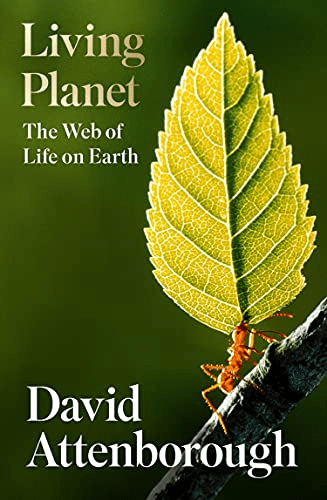
Book blurb:
Nowhere on our planet is devoid of life. Plants and animals thrive or survive within every extreme of climate and habitat that it offers. Single species, and often whole communities adapt to make the most of ice cap and tundra, forest and plain, desert, ocean and volcano. These adaptations can be truly extraordinary: fish that walk or lay eggs on leaves in mid-air; snakes that fly; flightless birds that graze like deer; and bears that grow hair on the soles of their feet. In The Living Planet, David Attenborough’s searching eye, unfailing curiosity and infectious enthusiasm explain and illuminate the intricate lives of the these colonies, from the lonely heights of the Himalayas to the wild creatures that have established themselves in the most recent of environments, the city. By the end of this book it is difficult to say which is the more astonishing – the ingenuity with which individual species contrive a living, or the complexity of their interdependence on each other and on the habitations provided by our planet. In this new edition, the author, with the help of zoologist Matthew Cobb, has added all the most up-to-date discoveries of ecology and biology, as well as a full-colour 64-page photography section. He also addresses the urgent issues facing our living planet: climate change, pollution and mass extinction of species.
If you were a nature loving child in the UK, you would have grown up learning from David Attenborough and his many documentaries. His nature documentaries are always iconic, showing footage of animals that have never been seen on camera before, and with every new documentary that is released we learn even more about the incredible world around us. Even now, his documentaries reignite that fire within me to protect this planet and all of nature, and are my go-to comfort shows when things start to feel too much or I need an extra boost of motivation.
This book was no different, but it also provided a lot more history than I had expected. The book is structured by chapters that focus on a particular habitat – forests, jungles, frozen plains, open ocean etc – and each chapter provides an overview of how these habitats came to be and how they have developed over the years to become what we recognise today, all while weaving in stories about the different animal species that have lived in these habitats over the ages of our planet. I personally really enjoyed this aspect, as I find evolution a fascinating concept, and it was also interesting to hear about how the planet has changed geographically over the ages.
I did also appreciate that the book is very much written for your average everyday reader, in that there is very little scientific language used and all of the theories and concepts explained within the book are explained in an easy to follow and easy to understand manner. I listened to the audiobook too which was narrated by David Attenborough himself, and he speaks with such a genuine interest and passion for what he is reading that you feel entertained. I also find he just has the most calming of voices and listening to him speak about different breeds of anteaters was a surprisingly peaceful way to begin my daily commute.
I feel this is a book that you would need to read quite a few times though as there is so much information in it. I found myself a lot of times having to rewind the audio, as there were so many interesting comments made that at times felt like a throwaway comment: For example, I had no idea that the European elk is the exact same species as the north American moose. But this comment was made so casually that I had to rewind the sentence to just to make sure I had heard it all correctly. This book is full of these little pieces of information, and I feel that to really make the most of it, you either need to sit down with the physical book with a highlighter and sticky notes, or you need to listen to the book multiple times to catch all of the neat little facts that are just thrown in with every sentence.
The imagery is also very powerful and the narration takes you on a journey as it does with a visual medium, like the documentary series. No, you cannot see video footage of the termite colonies as their build their tunnels, but the scene is so well described that you feel like you are a little termite yourself, helping to build the nest you will call home. There is also so much feeling within the words, where even if you do not listen to the audiobook, you can still hear David Attenborough’s voice and his little sassy comments as he writes.
As with all of his work, the message is always very clear. the final chapter of the book talks about the threats to nature, and it is once again clear that climate change is the biggest threat to all of nature, including us. I have always liked that about the David Attenborough works, as the message always relates to humans as well. It is never ‘us vs nature’, it is ‘us with nature’, and all of the threats to nature are also a threat to our own existence on this planet. Yet the message is always quite hopeful, as in this book he uses real life examples of how nature has been damaged and how people have come together to fix it and help nature recover again. The books message is always one of hope, and it has once again left me feeling very inspired to take action.
 Taylor Talks Vegan