
Book Blurb:
Cows are as varied as people. They can be highly intelligent or slow to understand, vain, considerate, proud, shy or inventive.
Although much of a cow’s day is spent eating, they always find time for extra-curricular activities such as babysitting, playing hide and seek, blackberry-picking or fighting a tree.
This is an affectionate record of a hitherto secret world.
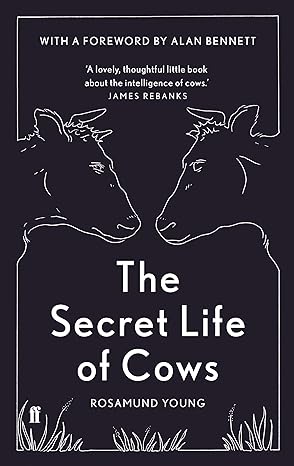
I will start this review by making it clear that the animals are very much product in this book. Yes, Rosamund Young speaks about the animals she raised with a lot of love, respect, and compassion, but the animals were still a product for family: Her family kept these animals for profit rather than for companionship. I am more of an animal rights advocate rather than welfare, but at the same time I appreciate that these two concepts are two sides of the same coin. To have high welfare is to accept that animals have certain rights, and in order to enforce rights, you have to improve welfare and keep standards high. I do not think they can be entirely separated out. I do also accept that a lot of these stories are from her childhood, around the 80s-90s, where views around animal welfare and rights were very different to how they are. With this in mind then, I do think that her families approach to farming was very liberal for the time period as they were farming their animals with a very high focus on their welfare and were, so far as the book suggests anyway, very much a free range farm where all of the animals had a lot of freedom.
I was also very surprised by the very strong position that Rosamund Young takes on organic farming, and throughout the book she is a very vocal advocate for organic farming and free range farming. Throughout the book, there is a very big focus on animal welfare and high welfare standards, and the version I read had an additional foreword that was very critical of factory farming, both from a welfare perspective and also from a business perspective. Young makes it very clear that in her opinion, animals suffering from low welfare produce low quality meat, and therefore it makes sense from a business and financial perspective to have a high level of welfare on any farm so that the product produced is of a high quality and can be marketed as such, resulting in more money for the farmers. I am not a farmer – nor would I ever be one – but I did find it interesting that Young does try to appeal to them throughout this book by showing how rewarding and (I guess most importantly) how profitable her family farm was as an organic and high welfare farm.
As to the book itself, Young is an oddly charming narrator. I listened to the audiobook version which is narrated by Young herself, and she is very funny – and I don’t know if that was intentional or not. Young is clearly a very well spoken and intellectual woman in her day to day life which was adamant from her very posh British accent as she spoke, which just made the stories funnier when she was speaking about the very silly names she and her family came up with for their very many animals on their farm – my favourite were the Hat Family, who included Fat Hat (the first and second), and Blue Bonnet. Which is another wonderful aspect of the book. It is very clear throughout the book that Young and her family did care for the animals on her farm. Whilst the title is focused on cows, and the majority of the stories are about the cows, she does also drop little stories throughout about the chickens, lambs, and pigs that she also farmed. The stories make this clear how much they would do for their animals, hand rearing a lot of them and working tirelessly to ensure that each cow’s individual needs were met as much as possible. It was also interesting to hear how each of the family had their own relationships with the various animals on the farm, with each of them forming very strong and close connections to some of the animals during their time on the farm.
Young writes as though the animals can truly talk, which not only added a lot of heart and character to the stories, but also made me relate to the stories better. If you have ever spent time with an animal in any capacity then you will know that animals definitely have their own ways of communicating, and I think Young does a wonderful job of highlighting how each animal had their own little ways of letting her know when they were annoyed, or happy, or hungry. She does this with all of the animals too, not just the cows, so the chickens feel just as alive as the cows do, and the pigs sound just as sassy as the lambs are. It also felt very genuine: she didn’t add this in to make the story sound better (at least, it didn’t come across as such) and felt very much like this is exactly how Young saw these animals.
The stories are very real too, and I appreciated that the stories were not just funny anecdotes about silly behaviours. She talks about how scary the bulls could be, with one of the stories of an escaped bull having quite a lot of tension throughout. She talks about how the various cows took to motherhood, and how they all developed their own relationships with one another. Some of the cows took to motherhood like a dream and were wonderful, loving mothers to their calves, whilst others were completely disinterested in the entire ordeal and sometimes even needed to be tricked into letting their calves suckle. It was refreshing to se her say at the beginning of the book that cows can be complex creatures, and then genuinely followed that statement up with examples of just how varied their different personalities could be. She also did this with the chickens and the pigs, which again were nice little extra touches.
I also very much enjoyed the lists at the end of the book which listed very clearly things that everyone should know about cows, chickens and pigs. Almost all of the points in the list related back to a story told earlier in the book, but also provided some fun little points of trivia about animals that you probably wouldn’t know unless you had spent time with them. I won’t list them here, but a few of them did catch me by surprise and I thought it was a very fun way to end the book.
The only issue I had with the stories is that they were all quite short. I fully appreciate why this was, as it would have been impossible to tell a full life history of every single animal that she has ever had on her farm, but I do think maybe a few extra chapters would have been very welcome. I know that she does have other books, and these books focus on the other animals in her farm, so I am tempted to give these a read to see what shenanigans they all managed to get up to. I do not believe that I was really the target audience for these books though – I already believe that animals are complex and exciting beings with their own experience of the world, so reading this book simply further confirms that belief. I do feel that her books are aimed more to those who do not believe that animals have feelings or their own little worlds that they live in, as this did feel like an introduction to the idea rather than a continuation. So whilst I may not agree with how she has these animals (i.e. the whole farming aspect) I can see how this sort of book could be quite eye-opening for other farmers who perhaps may never have thought of this. I feel a lot of the stories could be very relatable to other stories, where no doubt they likely have animals on their farms that have behaved similarly to how Young’s animals behaved. I think this book could do a lot of good to help shift people’s perceptions of animals and I always want to be supportive of any book that attempts this.
 Taylor Talks Vegan