
Story Blurb:
Varjak Paw is a Mesopotamian Blue kitten, who lives high up in an old house on a hill.
He’s never left home, until he receives a mysterious visit from his grandfather who tells him about The Way – a secret martial art for cats.
Now Varjak must use the Way to survive in a city full of dangerous dogs, cat gangs and, strangest of all, the mysterious Vanishings. This award-winning story has become a modern classic. A celebration of friendship, loyalty and difference, Varjak Paw is an adventure like no other.
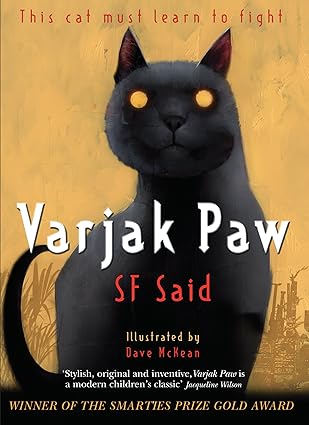
It has come to my attention that so many stories about animals are aimed at children, which is somewhat disappointing for us adults who want to read stories about animals that are actually aimed at adults. Don’t get me wrong, some of my favourite books are technically aimed at children, but I am noticing a real gap in the market.
This story, Varjak Paw, was always one I had wanted to read as a child but for whatever reason I never actually did. Which is surprising because reading it now as an adult, ten year old me would have absolutely obsessed over this book. Yes it is written for children, but the overall themes of the book are actually quite macabre, and even as an adult there were certain images within it that genuinely creeped me out. Which is just the book that young me loved to read. The book is advertised for children aged around 6-8, but personally I think it’s a bit better for slightly older children, a round 10, simply because I do think some of the imagery used may be a bit too gothic for younger children. Unless of course your child is into that sort of thing in which case…they’d love this!
As with all of my book reviews, I won’t discuss too many plot points of the story, as I don’t want to spoil any of the plot points just in case any of you do choose to read the story. To put it simply, this is a story of Varjak, a pedigree cat who, due to a series of events in his home, has to leave his pampered home and learn how to be a cat of the streets so that he can save his family home. It has a few elements of magic to it, in that a lot of his lessons are taught to him by his ancestors in dream sequences, but the majority of the story is very much grounded in reality. It tells the story of how Varjak learns how to be a ‘true cat’, essentially learning how to fight and hunt so that he can return to his home and save his family from an evil presence. Along the way he meets various different characters who all help him learn how to be a true cat and the story ends in a very satisfying manner, where all of his lessons finally come together and he is able to beat the Big Bad of the story.
The Big Bad in this story is quite a creepy one. I won’t spoil what the Big Bad is but needless to say it was not at all anything I was expecting, and some of the imagery used to hint at the Big Bad were really good. The reveal also carried with it the right amount of shock, fear and disbelief that you would expect, and again I found this helped keep the book quite grounded. That being said, the Big Bad is quite a bizarre reveal and is actually quite an outlandish concept. Personally, I think this helped. The Big Bad is actually quite a terrifying idea, and had it seemed realistic to our every day lives it probably would be far more disturbing than would be suitable for the young audience that this book is aimed at. The Big Bad is just outlandish enough to make you suspend your belief, and very much reinforce the message that this book is a work of a fiction and it is all made up. As much as ten year old me loved the darker and more gothic stories, I doubt that this book would have been as successful had the Big Bad been more realistic.
Varjak himself is very relatable. He starts the book as a very pampered purebred cat of a rich family, and so he is very naïve about what the world is really like outside of his gated walls. The blurb describes him as a kitten, so it is very easy to relate to his journey of learning how to survive in the big scary outside world. But whilst he is naïve, he is not a dumb cat, and in many situations he is saved by his quick thinking. His naivety also makes him very friendly, as he knows no better, and whilst this is seen as a negative by some of the other characters he meets along his journey, it does mean that he makes friends with unlikely characters – such as a dog for example – because he has no real preconceptions on who he is to interact with others. He is a great main protagonist and I was definitely rooting for him as soon as I was introduced to him.
The other characters are also well defined, although with it being aimed at children they can sometimes be a little bit one dimensional – one character is jaded, one is stupid, one is the voice of reason etc. Whilst a few of the characters do have a tiny bit of development over the course of the story, it is made very clear that this is not their story. Varjak is the main character so the focus is on Varjak. Personally I don’t mind this – I again repeat that this is made for children – and whilst the other characters may be quite simple, they are consistent and likeable in their own little ways, so I didn’t really feel like they needed more.
I did find the story engaging and interesting, but at the same time it did seem to move quickly. Varjak has to learn these special cat traits in order to become a true cat, and he appears to pick these up very quickly and without any real issue. This is passed off in the book as Varjak simply learning to trust his instincts (so essentially ‘the power was really inside him all along’) and to trust in his ancestors, but it might have been interesting to see him struggle with at least one of them. For example, he has spent his whole life a pampered kitten in a large house and with no dangers, yet he learnt how to hunt after one lesson and never really struggled with it. I think I would have liked a little bit more time spent on him learning how to really master these skills – or to see him struggle to master at least one of them – rather than simply being told how to do it and then being great at it simply because of ‘instincts’. Again, I give the book grace as it is meant to be for children and I appreciate that there likely wasn’t enough word count to include these little extras, but I do think it always helps to see a protagonist struggle at some point so that we as the reader can root for them to overcome the struggle, but also to relate to that struggle.
 Taylor Talks Vegan